In this paper, the topic of digital halftones, or dithering, is discussed. In particular, the methods of implementation are discussed for the three classical categories which are random, ordered, and error diffusion dithering. A good understanding of dithering is necessary prior to understanding how and when dithering is necessary or beneficial to the designer. This paper includes discussions of specific types of dithering including one of the most popular techniques called Floyd-Steinberg and also includes actual implementations in MATLAB [See Appendix]. Several applications will be discussed that encompass not only image processing but audio signal processing, and optics.
Showing posts with label Digital Image Processing. Show all posts
Showing posts with label Digital Image Processing. Show all posts
Friday, January 7, 2011
Dithering Methods and Applications


Wednesday, October 14, 2009
Image Processing: Dithering Presentation
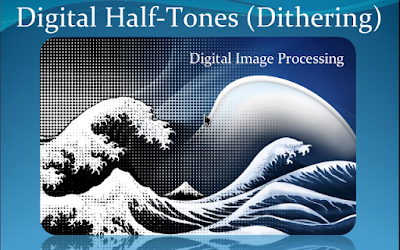
Here is another presentation I made a couple years ago for my class in Digital Image Processing. I presented on a very interesting concept called dithering. In this presentation, I discussed several methods of dithering (one of the more interesting methods being "error diffusion"). Check it out.
Dithering Presentation
Hopefully in the near future I will actually post my code for this project, so that people with interest in the topic can play around with the code. My matlab code had support for all the popular, well known, dithering algorithm out there, as well as some more interesting concepts such as image fusion via dithering.
Friday, July 17, 2009
Digital Image Processing
Are you interested in Digital Image Processing (DIP), but don't know where to start? Well, I have good news there are two routes that just might suite your needs. First is Matlab's Toolbox for Image Processing. The DIP Toolbox is a very powerful set of commands that will make image processing as easy as pie. Not to mention that Mathworks has excellent documentation on all its functions. However this might not be an option for some, since it does cost money if your university doesn't have access to it.
The other highly regarded option is to get OpenCV. OpenCV is the "Open Computer Vision" library written in C, meaning maximum performance. This library was originally created and developed by Intel Corp. which focused on optimizing the code as much as possible, and I have to say, they did a very good job, however, doing certain tasks that you take for granted in Matlab might not be an easy task for OpenCV and C/C++. If you want to learn more about OpenCV, I suggest using the Yahoo! Group called OpenCV. This group is a very active community of imaging experts and novices that discuss anything OpenCV/imaging related. There is also a very nice book by O'Reilly that serves as an aid in learning OpenCV. Here are some links that I have found useful for OpenCV:
http://tech.groups.yahoo.com/group/OpenCV/?yguid=361088785
http://opencv.willowgarage.com/wiki/wiki-static/
http://www.seas.upenn.edu/~bensapp/opencvdocs/
http://www.cs.iit.edu/~agam/cs512/lect-notes/opencv-intro/opencv-intro.html
The other highly regarded option is to get OpenCV. OpenCV is the "Open Computer Vision" library written in C, meaning maximum performance. This library was originally created and developed by Intel Corp. which focused on optimizing the code as much as possible, and I have to say, they did a very good job, however, doing certain tasks that you take for granted in Matlab might not be an easy task for OpenCV and C/C++. If you want to learn more about OpenCV, I suggest using the Yahoo! Group called OpenCV. This group is a very active community of imaging experts and novices that discuss anything OpenCV/imaging related. There is also a very nice book by O'Reilly that serves as an aid in learning OpenCV. Here are some links that I have found useful for OpenCV:
http://tech.groups.yahoo.com/group/OpenCV/?yguid=361088785
http://opencv.willowgarage.com/wiki/wiki-static/
http://www.seas.upenn.edu/~bensapp/opencvdocs/
http://www.cs.iit.edu/~agam/cs512/lect-notes/opencv-intro/opencv-intro.html
Subscribe to:
Comments (Atom)